Cookieless web analytics · in development
Know what people read. Not who they are.
For blogs, documentation, and long guides: Tereon shows how far readers get through each section of a page and how long they stay there. It sets no cookie, stores nothing on the reader’s device, and cannot recognize anyone from one day to the next.
- Status
- In development; not available yet
- Next
- Running on our own sites
- Legal review
- Pending
- Client script
- 3.3 kB, nothing stored
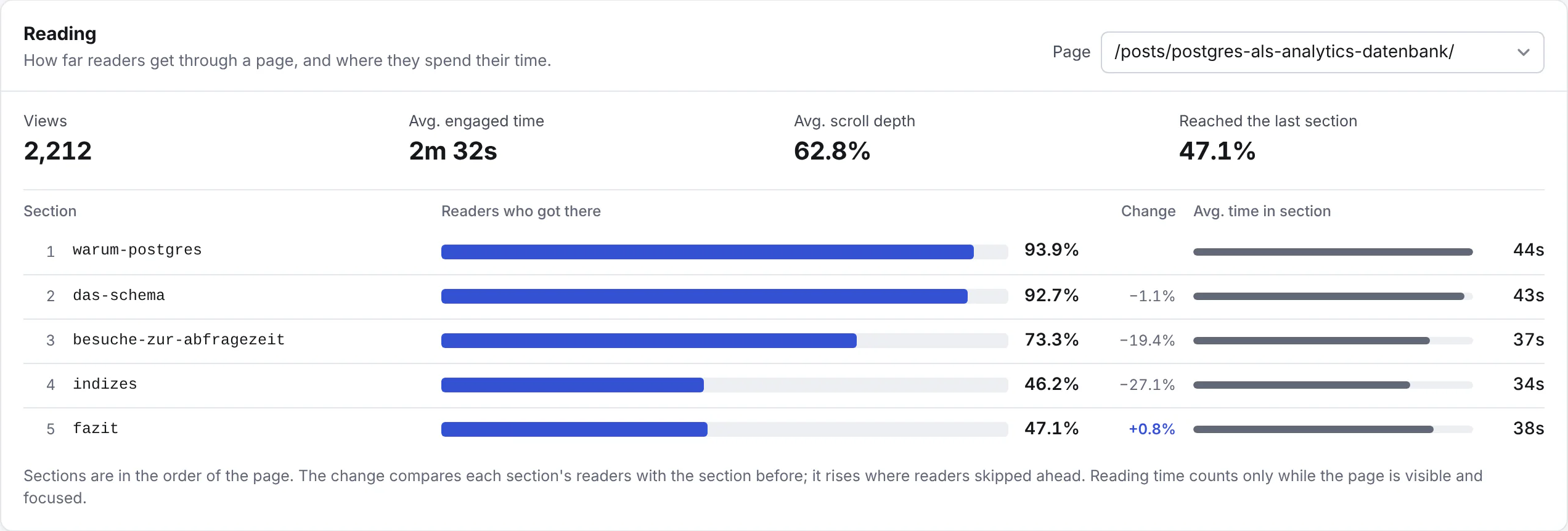
The reading view
Which part of the article did they actually read?
Page views say a post was opened. Average time says little more. Tereon splits every article at its headings and measures each part on its own, so you can see where readers stop and which section holds them.

Reach per section
The share of page views that spent any time in a section. When 94% get to the first section and 46% to the fourth, the article loses half its readers somewhere in the third.
The change between sections
How many readers the section lost or gained compared with the one before. A rise means readers skipped ahead, often to a conclusion or a code sample.
Time per section
The average engaged time a section held a reader. Time goes to the section in view: the last heading above the middle of the screen.
The idle rule
A tab left open is not a reader. Time counts only while the page is visible and focused and the reader has given a sign of presence in the last 30 seconds: a scroll, a pointer movement, a key, or a focus. After 30 quiet seconds the clock stops until the next sign. The 30 seconds are kept, so someone who sits still through a long paragraph is counted in full, and someone who walks away adds at most half a minute.
Video playing on the page does not count. Readers who read one screen for more than 30 seconds without touching anything are undercounted; we chose that over crediting forgotten tabs with an hour.
<article>
  <h1>Postgres as an analytics database</h1>
  <h2 id="why-postgres">Why Postgres</h2>
  …
  <h2 id="the-schema">The schema</h2>
  …
</article>
The rest of the dashboard
Everything else a site owner expects to see.
One page, one period, every panel answering the same filter. All screens below are the real dashboard with two months of demo data for two invented sites.
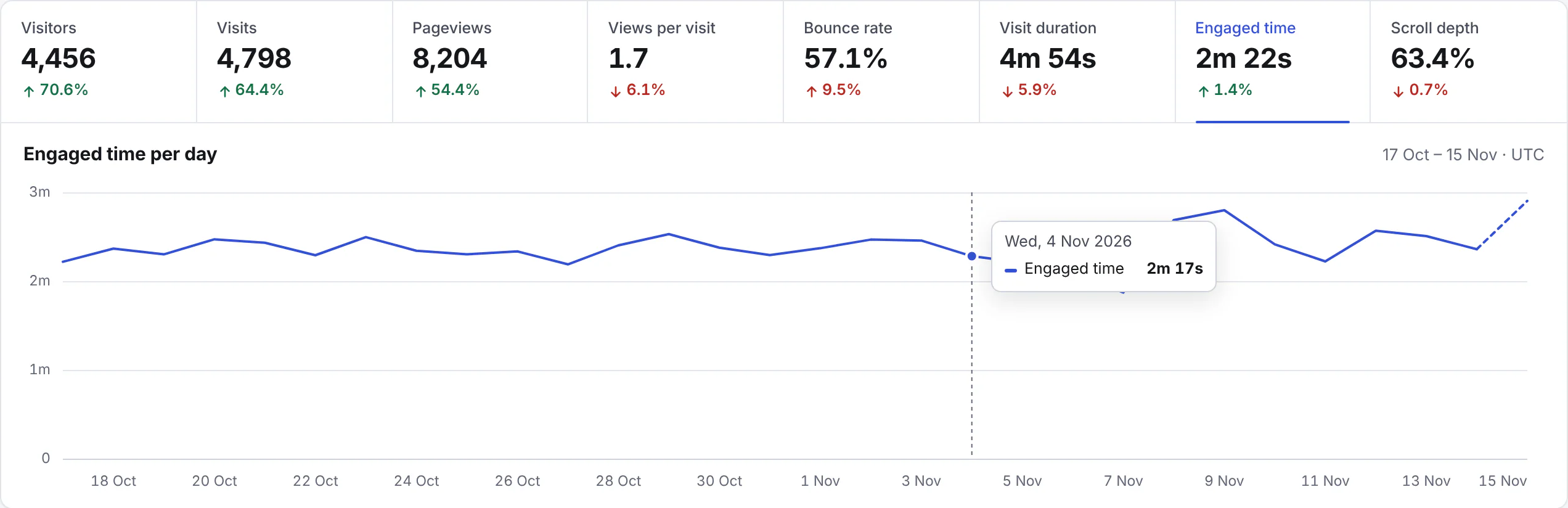
Visitors, visits, and how they behave
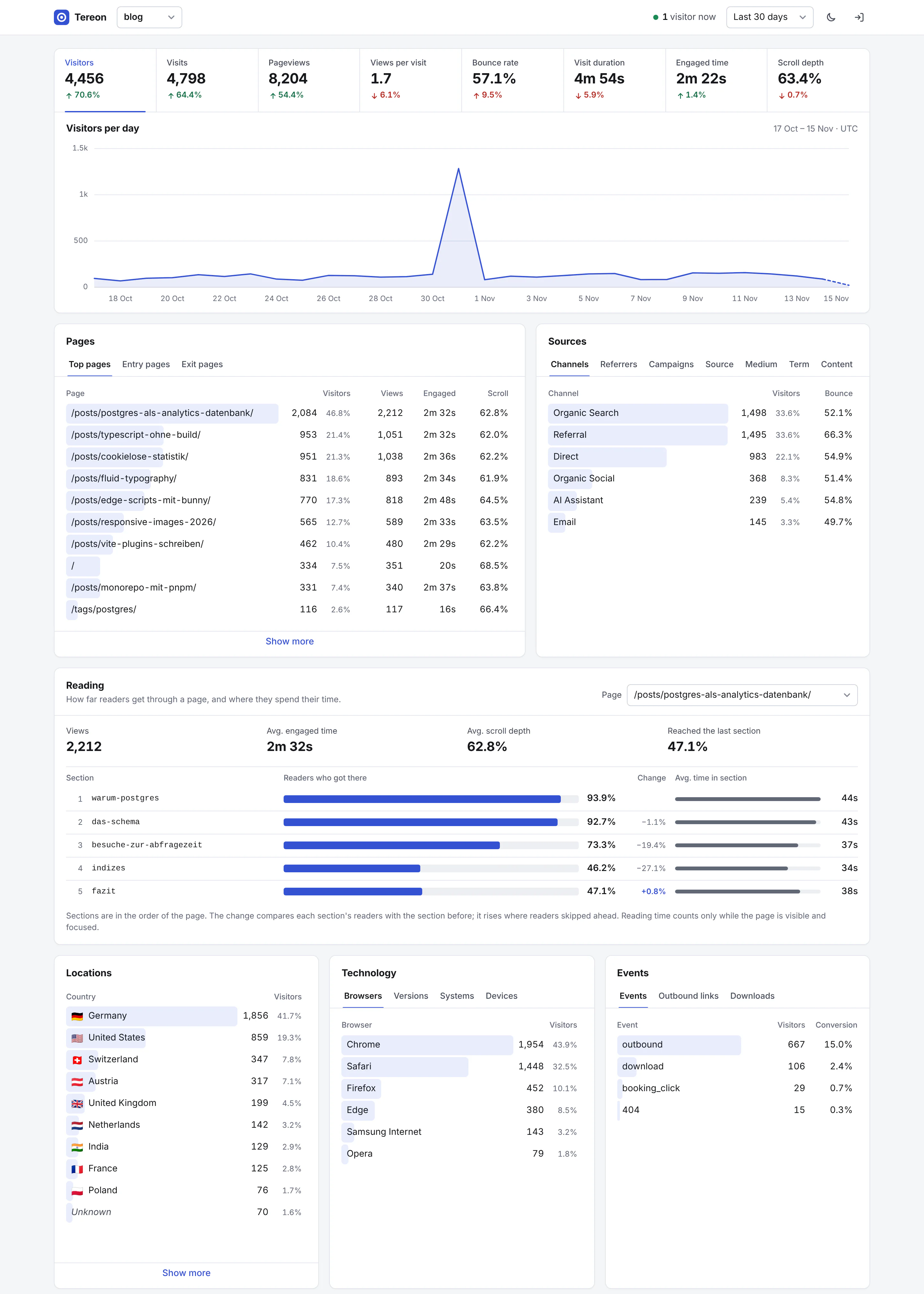
Eight headline numbers, each compared with the period before: visitors, visits, page views, views per visit, bounce rate, visit duration, engaged time, and scroll depth. Choose a number to chart it per day; the crosshair follows the pointer or the arrow keys.
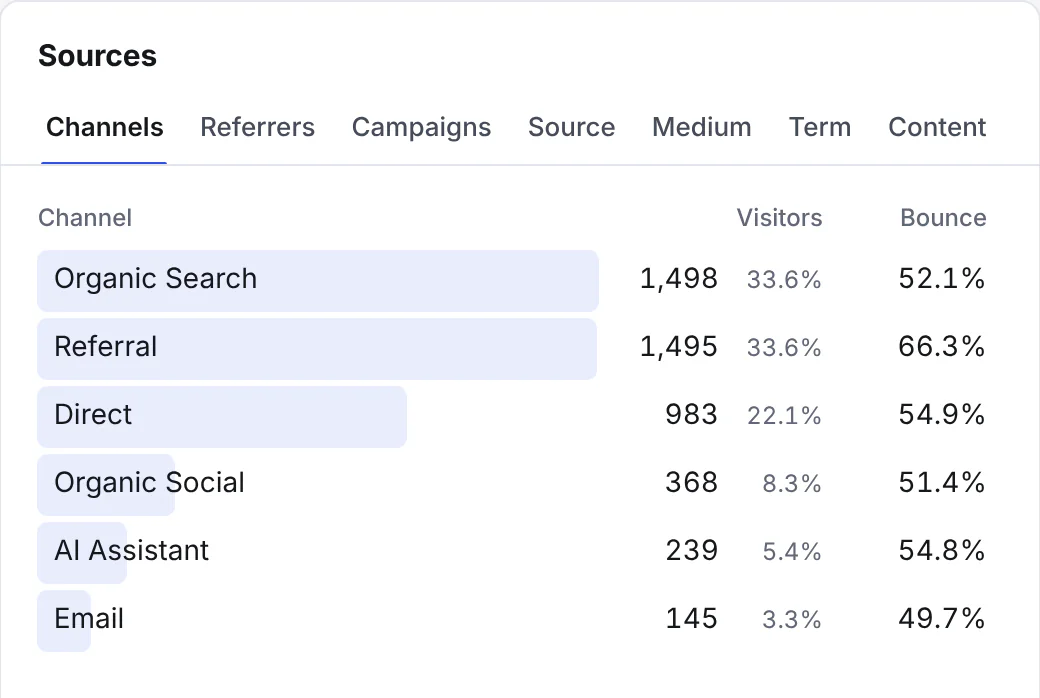
Where visits come from, including AI assistants
A visit’s source is the referrer and campaign tags of its first page view. Tereon groups them into nine channels, one of which is AI Assistant: visits from ChatGPT, Perplexity, Claude, Gemini, Copilot, and similar tools, counted on their own instead of disappearing into Referral. Campaigns, referrers, and every UTM field have their own tabs.
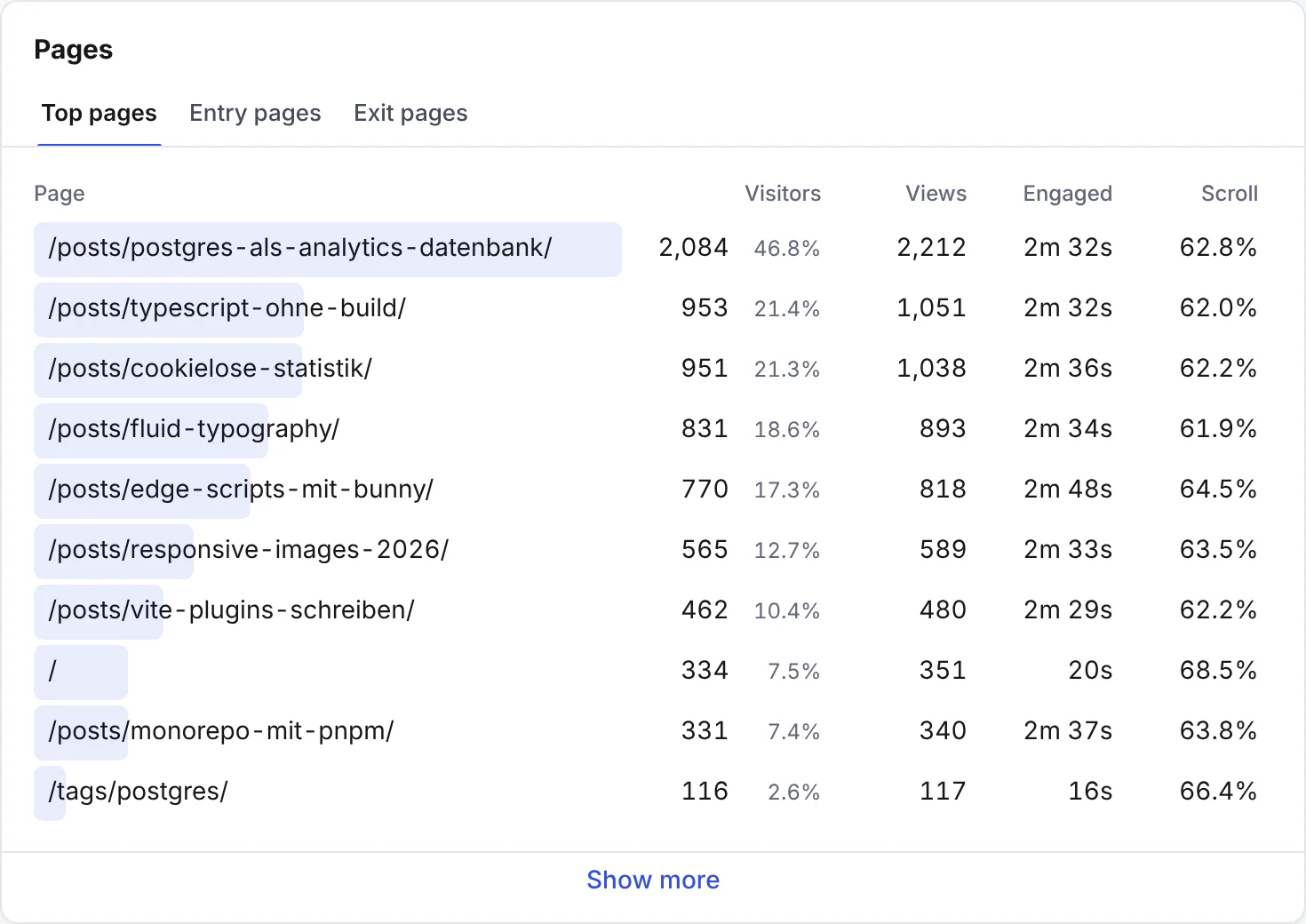
Pages, with time and depth beside each
Top pages, entry pages, and exit pages, each with visitors, views, engaged time, and scroll depth. Paths are stored without query strings, so one article is one row.
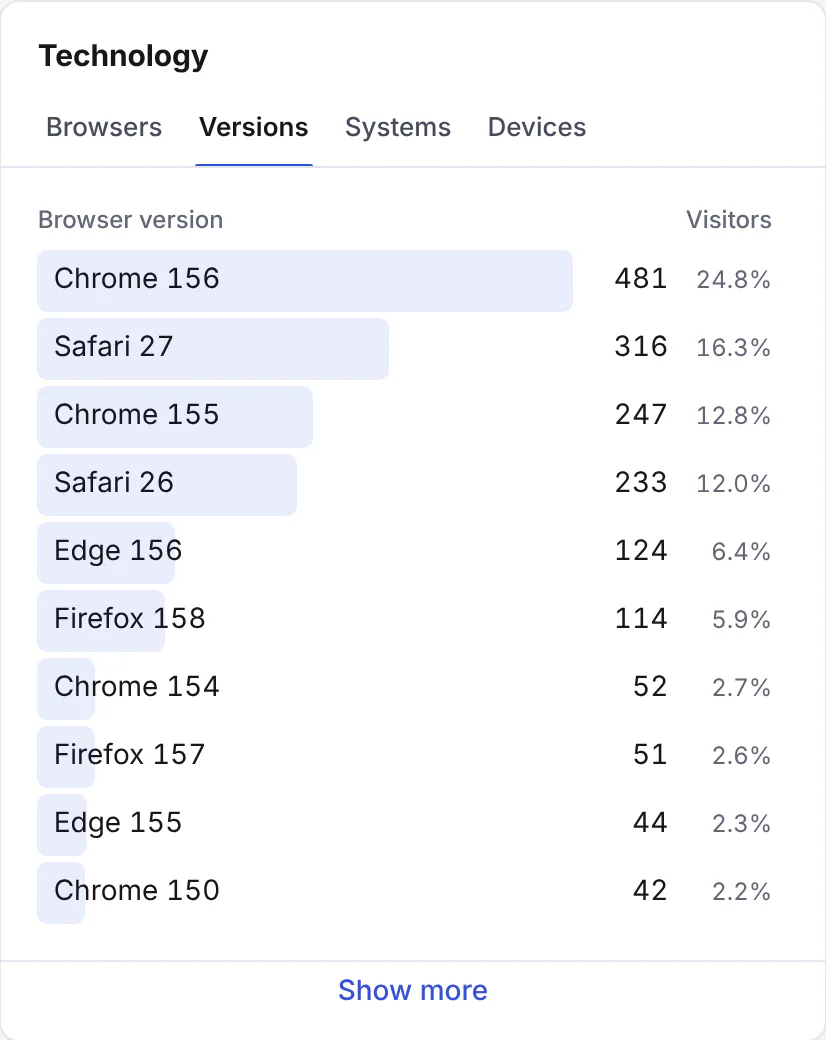
Technology
Browsers with their versions, operating systems, and device classes, derived on the server from the browser’s own request header. No screen size, no language, no time zone.
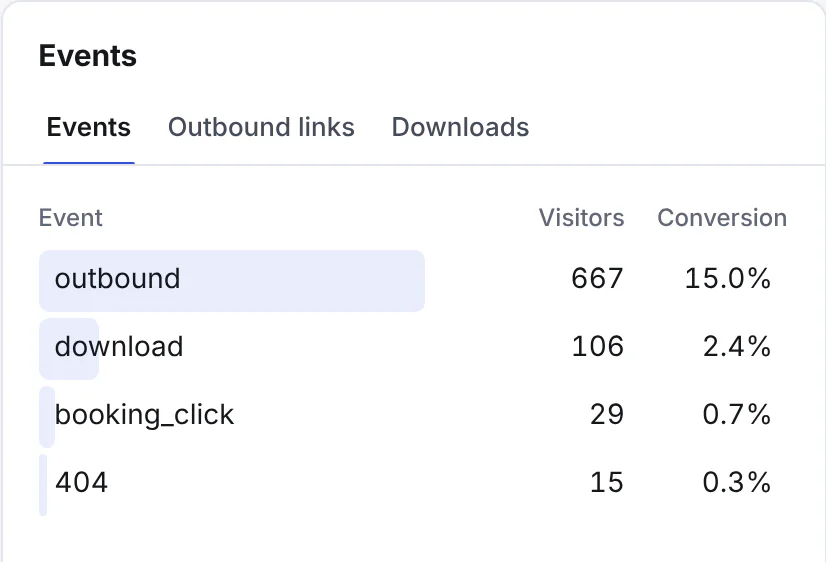
Events and conversions
Outbound links, downloads, and not-found pages are recorded without setup. Your own events, such as a booking click, show the share of visitors who triggered them.
Sign-in
The dashboard is private. Today everyone signs in with one shared password; there are no individual accounts yet.
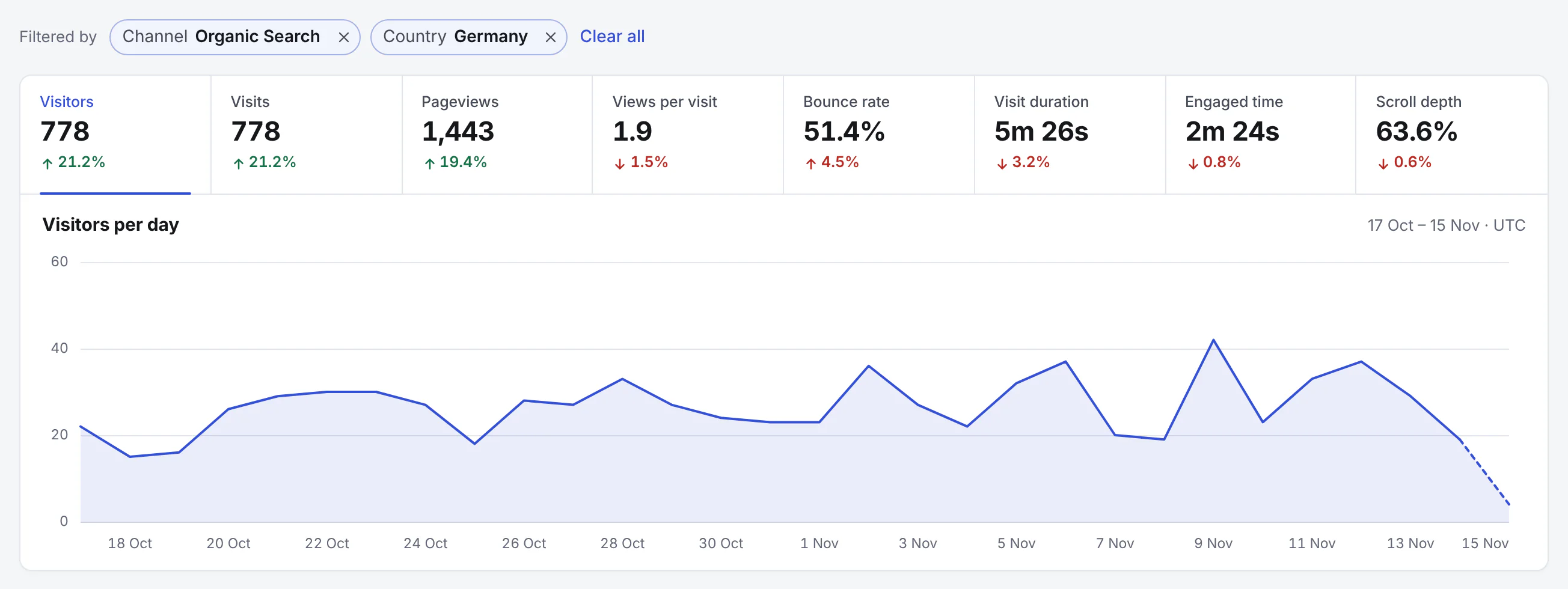
Filters that apply everywhere
Click any row, a channel, a country, a page, a browser, and every number and panel narrows to it. Filters combine, show as chips, and live in the address, so a view can be bookmarked or sent to a colleague.
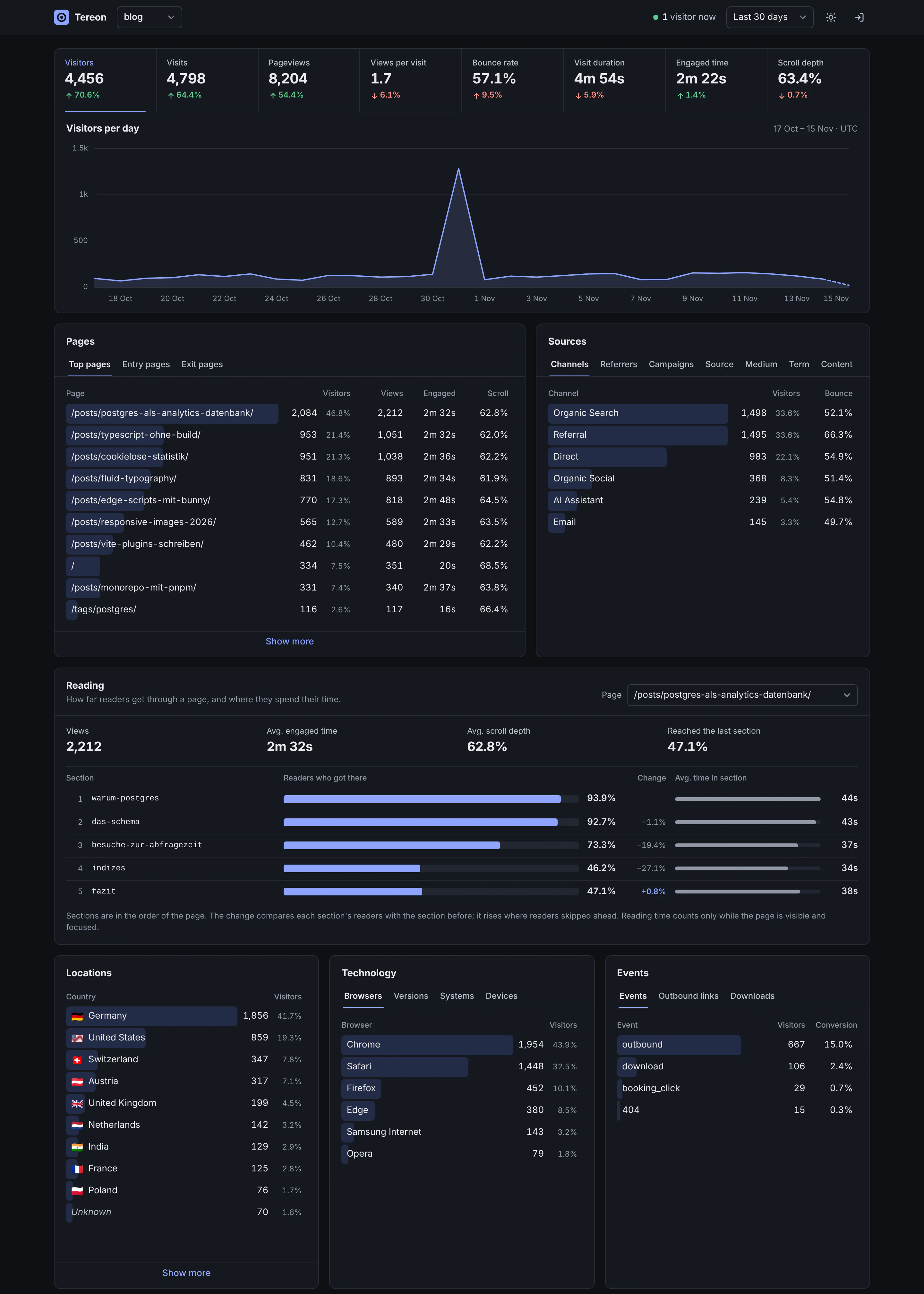
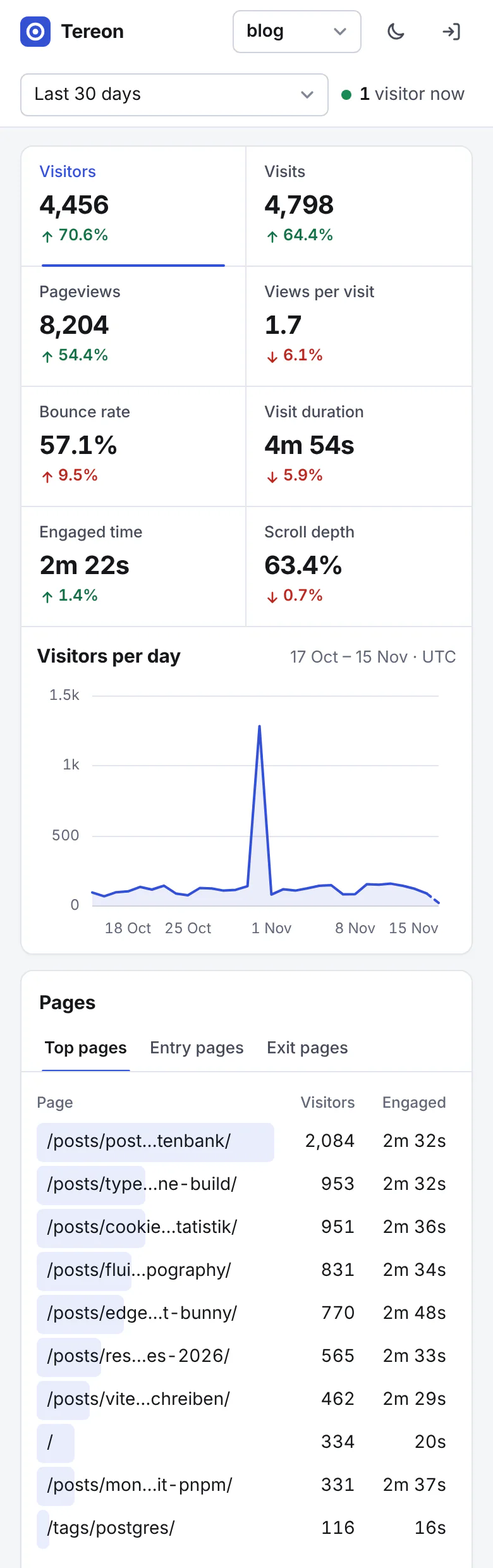
The whole page, light and dark, on any screen
The dashboard follows the system’s light or dark setting and works on a phone. It loads nothing from any other host.
On your site
One script tag. Everything else is optional.
The client script is 3.3 kB, 1.7 kB gzipped. It sends a page view when a page opens and one small message with scroll depth and time per section when the reader leaves or hides it.
<script defer src="/_s/t.js"></script>
https://<collector>/t.js instead.<a href="/book" data-tereon-event="booking_click">
Book a call
</a>
<meta name="tereon:status" content="404" />
window.tereon?.event("profile_pdf_download", {
  profile: "jane-doe",
})
Privacy by construction
What it keeps, and what it never sees.
Tereon was designed so that a site can measure reach without storing anything on the visitor’s device and without recognizing anyone beyond a single day. Here is exactly what that means.
| Stored | Never stored |
|---|---|
| Site, hostname, and path, without the query string | IP address |
| Referrer host and campaign (UTM) tags | The full User-Agent header |
| Country code, from the delivery network’s request header | Query strings and full referrer URLs |
| Browser with major version, operating system, device class | Screen size, language, time zone |
| Scroll depth, engaged time, time per section | Cookies, local storage, any device id |
| Named events with small, flat properties | Anything typed into the page, or its text |
| A visitor id that changes every day, cleared after 400 days |
site            blog
kind            engagement
hostname        blog.example.com
pathname        /posts/edge-postgres
referrer_host   www.google.com
utm_source      newsletter
country         DE
browser         Firefox 147
os, device      Linux, desktop
scroll_depth    72
engaged_ms      48210
sections        {"setup":[0,12040],"results":[1,30170]}
visitor_id      -4812736451209938171
A visitor id that forgets itself every day
- 1
For each message, the collector hashes the site, the visitor’s address, and the browser header with HMAC-SHA-256 and a key of 16 random bytes for the current UTC day. It keeps the first 64 bits as the visitor id; the address and header are used for that one step and never written anywhere.
- 2
The first message of the next day creates a new random key and deletes the old one. The key was never derived from anything, so it cannot be recreated.
- 3
Yesterday’s ids can no longer be linked to today’s, or to another site. Unique visitors are exact for one day; over a month, someone who returns is counted again.
Nothing on the device
No cookie, no local or session storage, no other device storage. The script reads no screen size, language, or time zone.
Objection without a cookie
Browsers that send
Sec-GPC: 1orDNT: 1get the same answer as everyone else, and nothing is stored.Retention
After 400 days the visitor id is cleared from each row. Page views, time, and scroll depth stay; visits and visitors of those days become estimates, and the dashboard says so.
Bots are dropped
Requests from known crawlers, and from browsers that announce they are automated, are answered and not stored.
No servers
No server to patch. No container to keep alive.
Tereon is two small programs on Bunny’s edge network and one table in Postgres. Nothing runs between requests, so there is nothing to keep up, and the raw rows stay in a database you own.
A collector on the edge
It checks each message, drops bots and objections, computes the daily id, and answers only after the row is written.
Postgres over HTTPS
Both scripts send SQL over HTTPS. No connection pool, no open port, and the dashboard’s database role can only read.
Append-only rows
One row per message. Visits, sources, and bounces are worked out when you look, so a better definition applies to all past data at once.
From the site’s own domain
The site’s middleware can forward
/_s/t.jsand/_s/eand sign the visitor’s address, so the reader’s browser contacts no other host.
How it compares
Where Tereon differs, and where it falls short.
Four tools many site owners know, against the same questions. The facts about them were read on each vendor’s own pages on November 13, 2026, for our competitor research; “not found” means we did not find it there, not that it does not exist.
| Question | Google Analytics 4 | Plausible | Fathom | Microsoft Clarity | Tereon |
|---|---|---|---|---|---|
| Reading time and reach per section | Only through custom events | Not found | Not found | Area maps with regions drawn by hand; attention maps | Yes, automatic from headings that have an id |
| Recognizes a visitor by | First-party cookies, kept for two years | A hash of a daily salt, the domain, address, and browser; salt deleted after 24 hours | A hash of address, browser, site, and a daily salt | A random id in a cookie | A hash of site, address, and browser with a random salt that is deleted daily |
| Stores on the visitor’s device | Cookies | Nothing; reads an opt-out flag | Nothing | First- and third-party cookies | Nothing |
| Scroll depth | One event at 90% | 1% to 100% | Not found | Scroll maps | Per page and per section |
| Engaged time | Time the page was in focus | Visible and focused; no idle timeout | A ping on departure, capped at 30 minutes | Not found | Visible, focused, and a sign of presence within 30 seconds |
| Session replay and heatmaps | Not found | Not found | Not found | Yes, both | No, by design |
| Funnels | Yes | Business plan | Not found | Yes | Not yet |
| Revenue reports | Yes | Business plan | Value and currency only | Partial | No |
| AI-assistant channel | Yes, since May 13, 2026 | Yes | Yes, since October 2, 2026 | Partial; AI Overviews not separable | Yes |
| Email reports and alerts | Email reports; anomaly alerts | Email and Slack; spike and drop alerts | Email reports | Weekly digest; traffic-drop alert | Not yet |
| Served from the site’s own domain | Google tag gateway | Yes, with a proxy you set up | Not found | Not found | Yes, through the site’s middleware; not yet tried on Bunny |
| Retention | 2 or 14 months | No limit on the Starter plan | While subscribed | Recordings 30 days; other data 9 months | Visitor id cleared after 400 days; the rest of each row is kept |
| Access to the dashboard | Five roles | Teams from the Growth plan | Not found | Two roles | One shared password |
| Client script | Not found | Not stated | About 2 kB | Not found | 3.3 kB, 1.7 kB gzipped |
| Where it runs | Google; EU data collected through EU servers | Plausible’s EU infrastructure, or self-hosted | EU traffic in the EU, other traffic in the US | Microsoft Azure; region not stated | Your own Bunny edge scripts and Postgres |
| Price at 10,000 page views a month | Free | $9 | $15 | Free | Not for sale |
Tereon’s column describes the code as built and tested on our machines, not a running service. Among the fifteen tools in our research, only Microsoft Clarity reports attention below page level, through regions drawn by hand. Prices are list prices per month. Corrections are welcome.
Which one fits.
- Google Analytics 4
- You need funnels, revenue, and advertising reports in one free tool, and you ask visitors for consent anyway; Google says consent mode is needed for visitors from the EU and the UK.
- Plausible or Fathom
- You want a hosted, cookieless service that works today, with email reports and an import of your Google Analytics history, for a monthly fee.
- Microsoft Clarity
- You want to watch recordings and heatmaps of real sessions, free of charge. Microsoft requires a consent signal for visitors from the EEA, the UK, and Switzerland.
- Tereon
- Your question is which parts of your articles get read, you would rather run the measurement in your own Bunny and Postgres accounts, and you can wait until it is ready.
What Tereon does not do.
No funnels or goal definitions yet.
Events show a conversion rate each; a multi-step funnel cannot be defined.
No session replay or heatmaps, by design.
They record far more than measuring reach needs.
No returning visitors or cohorts.
The visitor id changes every day, so someone who comes back tomorrow counts again. That is the price of not following anyone.
No revenue or e-commerce reports.
Tereon is built for content and marketing sites.
One shared password.
There are no individual accounts or roles, and access cannot be withdrawn from one person.
No email reports, alerts, or Search Console data yet.
Today the numbers are in the dashboard and nowhere else.
No documented statistics API.
The raw rows sit in your own Postgres, which you can query directly.
Reports read raw rows on every request.
Fine for small sites; large sites and long periods will need pre-aggregated tables.
Status
Where it stands today.
Tereon is built by Sebastian Software, a small software company in Mainz, Germany, first for its own websites. It is not a product you can sign up for.
Done
Runs locally
Collector, reports, and dashboard are tested against an in-memory Postgres and in a real browser. Every screenshot on this page comes from that setup.
Done
Published, not connected
Both edge scripts are published to Bunny. They are not connected to a database yet and serve no site; nothing has been verified on the live platform.
Next
Our own sites
Connect the database and measure our own sites. Then check what only the real platform can show, such as the visitor address the edge reports and where EU visitors are served.
Pending
Legal review
A briefing for a German data-protection review is written. The review has not taken place.
Later
The known gaps
Email reports, goal definitions, individual accounts, a documented API, Search Console data, and funnels. No dates.
Want to know which sections your readers reach?
Tereon runs on our own sites first. If you would like to hear when others can use it, or want to talk about measuring reading on yours, write to us.